Accounting Firms: How AI Finds the Information Your Teams Are Already Looking For
In an accounting firm the document almost always exists — the real cost is finding it at the right moment.
Client documents, invoices, bank statements, contracts, emails, deadlines: the work of an accounting firm rests on something that sounds simple — finding the right information at the right moment. The document almost always exists. But where? In the client folder, attached to an email, in last year's file, inside a scanned PDF, or in a colleague's inbox. So teams search. Again and again. This work shows up on no timesheet, yet it weighs on every day. It is the hidden work of accounting firms.
Searching client files
Client files grow every year. Inconsistent file names, scans, duplicates, documents filed under the wrong year: retrieving the right one often takes a few minutes. A few minutes per client is nothing. Multiplied across dozens or hundreds of clients, and across a whole team, it becomes a real but invisible cost — one that never appears on an invoice yet quietly slows every file down.
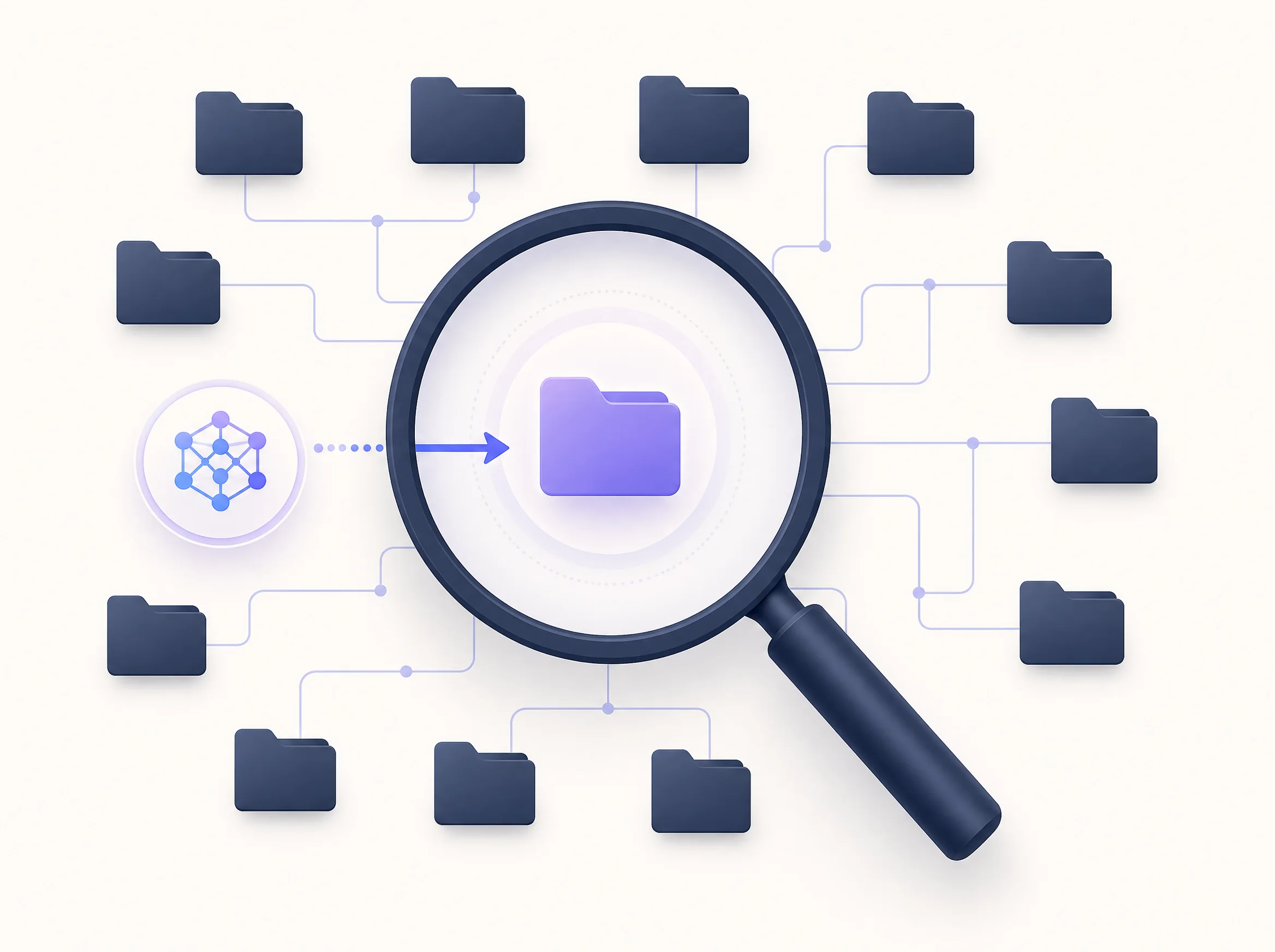
AI can search the documents in a file and surface a specific item from a plain-language question — where is this client's latest bank statement? — rather than from a folder path nobody remembers. The accountant stays in control: the tool suggests, the accountant checks.
The questions that keep coming back
“Did you receive my documents?”, “What's still missing?”, “When is the deadline?”. These questions come back constantly, and answering them often takes longer than writing the reply itself — because the information has to be found first.
An AI assistant can prepare the context before the accountant answers: what has been received, what is still missing, the date of the last communication, the upcoming deadline. The accountant reviews, adjusts and sends. The reply stays human and the tone stays yours; only the search that precedes it is lightened, so the answer takes minutes instead of a small hunt through folders and mailboxes.
Incomplete documents
When a document is missing, the work stops. The team sets the file aside, moves on, and comes back later — having to rebuild all the context lost in between. This stop-start work is expensive in focus.
AI can flag what is missing earlier by comparing a file against a checklist. Catching a gap at the start rather than mid-way through avoids back-and-forth and late follow-ups. The judgment on what is genuinely required stays with the accountant; the tool only raises the flag, and the file moves forward in one pass instead of several.
Summaries written by hand
The status of a client file, year-end preparation, review notes: these summaries are useful, but they take time to write. You reread, gather and format — before the analysis even begins.
AI can prepare a first draft: a file summary, a pre-closing status, a structured note. The accountant no longer starts from a blank page; they review, correct and complete. The first draft saves time; responsibility for the content stays whole.
Knowledge trapped in people's heads
In many firms, client context lives in the heads of experienced staff: the history, the quirks, the past decisions. If that person leaves, part of the firm's memory leaves with them. Reviewers, for their part, often spend more time hunting for supporting documents than exercising judgment.
A well-designed AI layer makes that context searchable — not to replace experience, but to keep from losing it — and puts supporting items in front of the reviewer faster, so their time goes to judging rather than digging.
What AI should not do on its own
Some things cannot be delegated. No automatic tax treatment, no filing or return without human validation. AI prepares, suggests and retrieves; it does not decide the interpretation or approve an official submission.
Accounting firms handle sensitive data. Before any deployment, you have to define who accesses what, where the data is hosted, how long it is kept and how confidentiality is guaranteed. At BeLogic these rules are set from the start — EU hosting, access control, deletion — because an accounting firm cannot afford vagueness here.
Where BeLogic fits
At BeLogic we help accounting firms use AI to reduce the information burden — client-file summaries, missing-document checks, document search, email summaries — with human review and controlled access. We design, build and deploy custom AI agents, from consulting to production, hosted in Europe and built for GDPR; we also help firms tap regional digitalisation subsidies. The accountant keeps what belongs to them: accuracy, interpretation and filing. AI does not replace professional judgment — it simply removes part of the search work that surrounds it, so the team can spend more of its time on the work only an accountant can do.