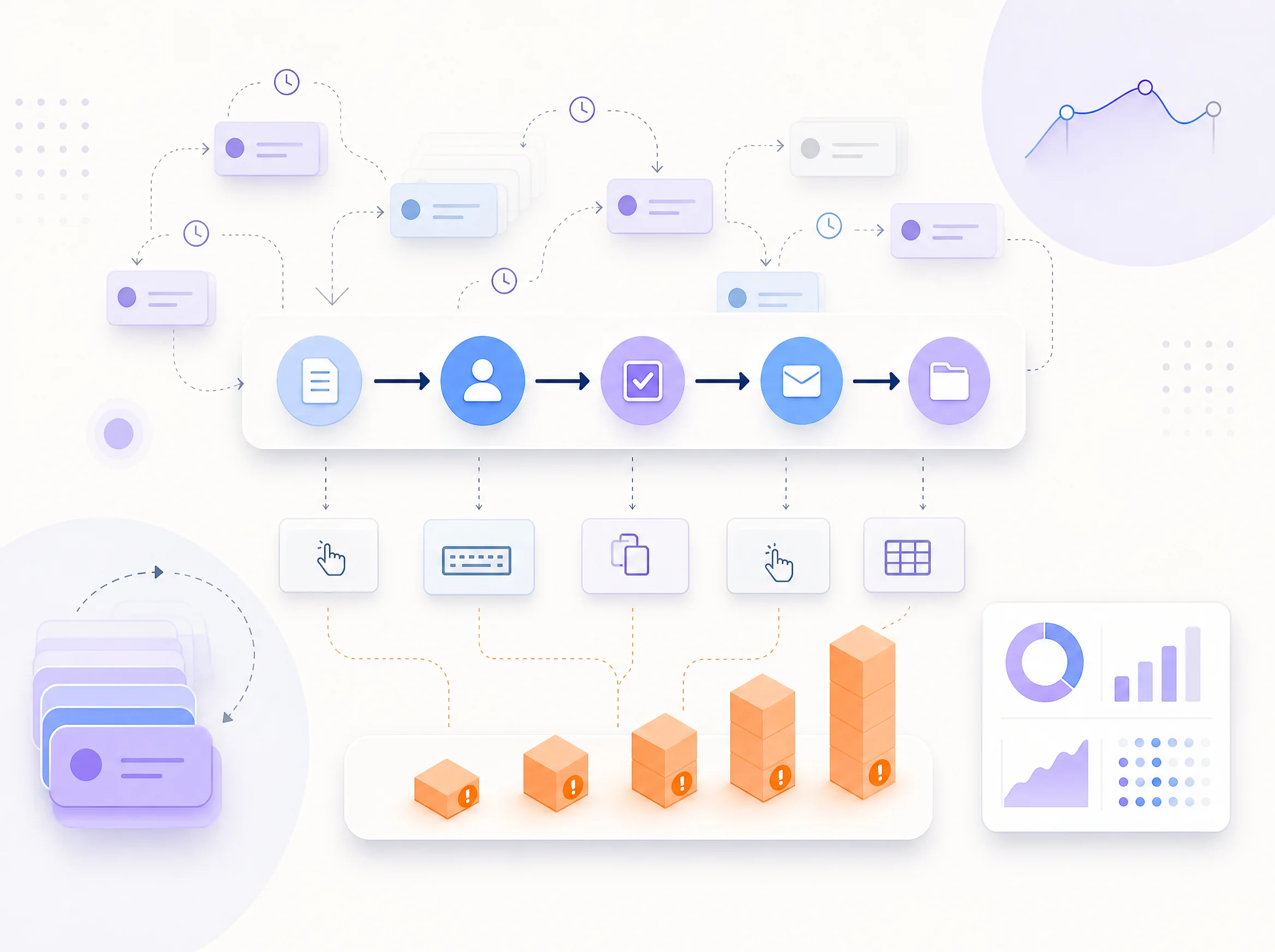
The Hidden Cost of Tasks No One Measures in Your Company
Companies measure the obvious costs. But some of the biggest never appear as a line item.
Salaries, software, rent, marketing — these numbers appear in reports and are compared against budgets. But the time employees spend searching for information, copying data between systems, rewriting the same email, waiting for approval, or answering the same question again never appears anywhere. Individually these tasks look small: five minutes here, ten there. Repeated every day across many people, they become expensive. The problem is simple — no one measures them, so no one sees the real cost.
The company feels busy, but the reason is unclear
Many teams are overloaded: they answer emails, join meetings, update spreadsheets, search documents, chase colleagues, fix small errors, repeat the same explanations. At the end of the week, everyone was busy — but what actually moved forward? This is where hidden tasks become dangerous: they create activity without visibility. A manager sees that the team is working hard, but not how much time is spent on low-value coordination. And attention is one of the most expensive resources in a company.
Searching, copying and repeated questions
Searching is one of the most underestimated costs. Information exists, but it is outdated, duplicated, in the wrong folder, or only in one person's head. If five employees each spend 20 minutes a day searching, that is a full working day every week — and the real cost is higher because searching breaks concentration. Copying information from email to CRM, from PDF to system, takes time, creates errors and prevents real-time visibility; no invoice says “manual copying: 14 hours this week,” but the cost is real. Repeated questions turn experienced employees into the company's internal search engine — their own work suffers, and the process depends too much on one person's memory.
Waiting, rework and inconsistency
Waiting looks passive but is expensive: a recruiter waits for criteria, the hiring manager waits for a shortlist, the candidate waits for feedback, and the company loses momentum. Pending work still has a cost. Rework means the company pays twice — first to do the task, then to fix it — and because corrections happen silently inside the team, they rarely appear in metrics. Inconsistent decisions appear when everyone handles the same task differently: customers receive different experiences, managers spend time checking, reporting becomes unreliable. This usually means the process is not structured enough.
Missed opportunities — and why these costs stay invisible
Some hidden costs are about what never happens: a lead not called back quickly enough, a strong candidate reviewed too late, a customer answered after they already chose another provider, a contract renewal forgotten. The company only sees the result later — lower conversion, longer hiring cycles, missed revenue. These costs stay invisible because they are small: they require no purchase order, appear in no accounting, happen between official tasks, and feel too normal to question. The problem is repetition — a small task repeated hundreds of times becomes a system cost.
What AI agents can make visible
AI agents can reduce hidden work — and also reveal it. An agent can show which questions are asked most, which documents are searched most, which requests are missing information, which tasks require repeated follow-up, and which processes depend too much on manual coordination. This helps managers stop guessing: instead of “the team is overloaded,” they can see where the load comes from — too many incomplete client files, too many candidates needing manual summaries, too many customer questions caused by unclear documentation. Once the pattern is visible, the process can improve. The best starting point is usually a task that is frequent, structured and time-consuming: summarising CVs, classifying requests, searching internal documents, preparing standard reports.
The cost of doing nothing
When hidden tasks are ignored, the company pays anyway: employees become overloaded, experienced people become bottlenecks, processes depend on memory, opportunities are missed, and AI projects become harder because the workflow is unclear. Many companies delay automation because they are unsure about the cost — while continuing to pay for hidden manual work every week. The cost is already there, distributed across salaries, delays, rework and missed opportunities. Measuring hidden work does not create the problem; it reveals it.
Where BeLogic fits
At BeLogic, we help companies find and reduce hidden operational work. We start by looking at the real process: where the request arrives, who handles it, what gets searched, copied or repeated, what needs human judgement, and what an AI agent could prepare. Then we design agents that reduce repetitive work, make information easier to find, structure incoming requests, flag missing details and give managers more visibility — for recruitment, HSE, customer calls, internal knowledge, accounting, medical offices or real-estate leads. Hidden tasks are expensive because nobody sees them. AI agents can make them visible — and then help reduce them. Because the work no one measures is often the work slowing everyone down.