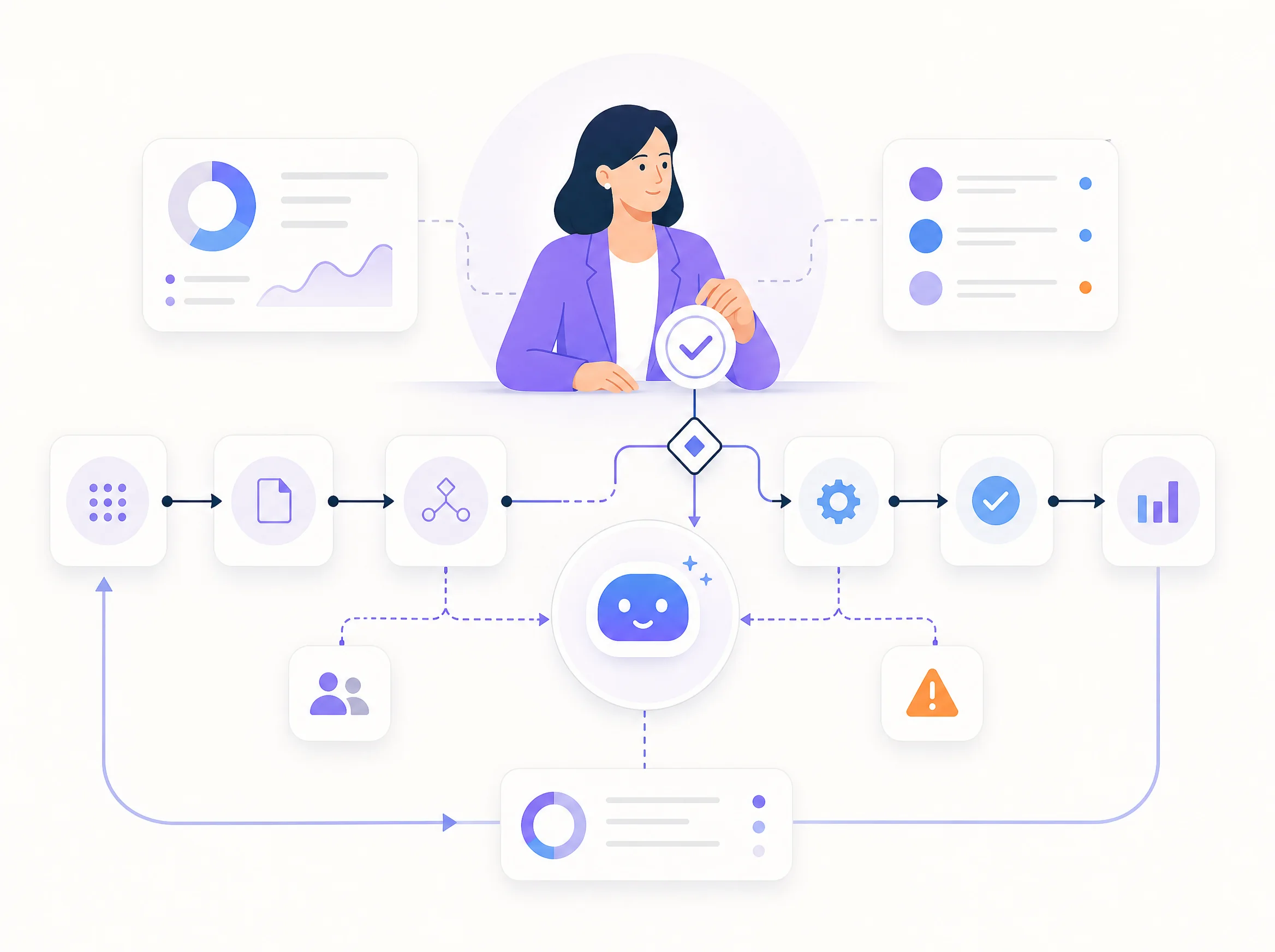
Automating Without Losing Control: The Human Role in an AI Agent
Automation is attractive. The real question: how much should the AI be allowed to do?
An AI agent can read documents, summarise information, classify requests, prepare answers, compare candidates, detect missing details and trigger actions in a workflow. That is powerful. But it raises a serious question: if the agent only gives suggestions, it may not save enough time; if it acts too freely, the company may lose control. The goal is to automate the right parts of the process while keeping people responsible for the right decisions. A useful agent does not remove human judgement — it gives human judgement better information, better timing and better structure.
Control should be designed before deployment
Many companies think about control too late — they build a prototype, then ask who approves the output and what happens if the answer is wrong. Before deploying, decide what the agent can do alone, what it can suggest, what requires human approval, what should be escalated, what should be blocked, who is responsible and what is logged. These questions protect against two failures: over-automation (the AI takes actions that should have stayed human) and under-automation (the AI becomes a fancy assistant that creates more checking work than value). Good deployment sits between the two.
Defining boundaries
An agent needs explicit boundaries written into the workflow — not vague instructions like “use AI carefully.” A recruitment agent can summarise CVs and suggest screening questions, but not make final hiring decisions. A medical-office agent can handle appointment requests but must escalate symptoms and emergencies. A legal agent can find relevant clauses but not replace legal judgement. In practice: the agent may draft but not send; recommend but not approve; classify but not reject; answer only from approved sources; escalate low-confidence answers; and log every action it takes. Boundaries give employees confidence and make the agent easier to manage.
Approving sensitive actions
Some tasks can be automated safely (summarising a public document, creating a meeting note); others need approval (sending a message to a client, rejecting a candidate, changing a financial record, giving medical guidance). The more impact an action has, the stronger the human approval should be — especially in recruitment, healthcare, legal, finance, safety and HR. The EU AI Act treats human oversight as a key requirement for high-risk systems. Approval does not have to be slow: the agent prepares the shortlist, the recruiter approves it; the agent drafts the response, the employee reviews and sends. The agent saves time without taking full responsibility.
Exceptions, quality and trust
Agents are useful for repeated patterns; business reality includes exceptions — an unusual request, an incomplete document, a non-traditional profile. A good agent recognises when a situation needs a person and escalates: when confidence is low, when sources conflict, when sensitive data appears, when the action affects a person directly. A good agent does not only answer — it also knows when not to answer.
Quality needs review, especially at the start: check whether summaries are accurate, sources relevant, escalations correct, time actually saved. A simple weekly check — review 20 outputs, list the errors, adjust the instructions — turns the agent into a managed system. Two opposite risks must be balanced: over-trust, where a polished answer is accepted too quickly (AI can be wrong in a convincing way), and under-use, where people ignore the agent and redo everything manually. The interface should show sources, highlight uncertainty and make review easy; training should explain when to use the agent and how their role changes.
Accountability and improving the process
Every agent needs an owner. Without ownership, nobody knows who corrects a mistake or prevents it from recurring. A business agent needs accountability at several levels — a process owner, a technical owner, a data owner, a decision owner for sensitive outputs — and in a small company one person may cover several roles, as long as clarity exists. Agents also reveal problems in the workflow: recurring questions, missing data, inconsistent criteria. The human role is to learn from the agent — automation should make the process more visible, then people can make it better.
What should never be fully automated
Every company should list the actions the agent cannot perform alone: final hiring decisions, candidate rejection without review, medical or legal advice, contract or financial approval, disciplinary decisions, safety-critical decisions, sensitive complaint resolution — anything involving significant rights, obligations or risk. The agent can still summarise, prepare, compare, check, flag and draft, but final responsibility stays with a qualified person. This protects the company and the people affected by the decision.
Where BeLogic fits
At BeLogic, we believe AI agents should help teams move faster without losing control of the process. Our agents are designed around real workflows, human review, clear boundaries and practical oversight — for recruitment, HSE, customer calls, internal knowledge, legal support, accounting, medical offices or real-estate leads. We define exactly what the agent should do (read, summarise, classify, draft, flag, escalate, log) and what stays human (approve, decide, interpret, communicate, handle exceptions, review risk). Automation should feel controlled — that is when teams trust it, managers can scale it, and AI becomes genuinely useful in daily work.