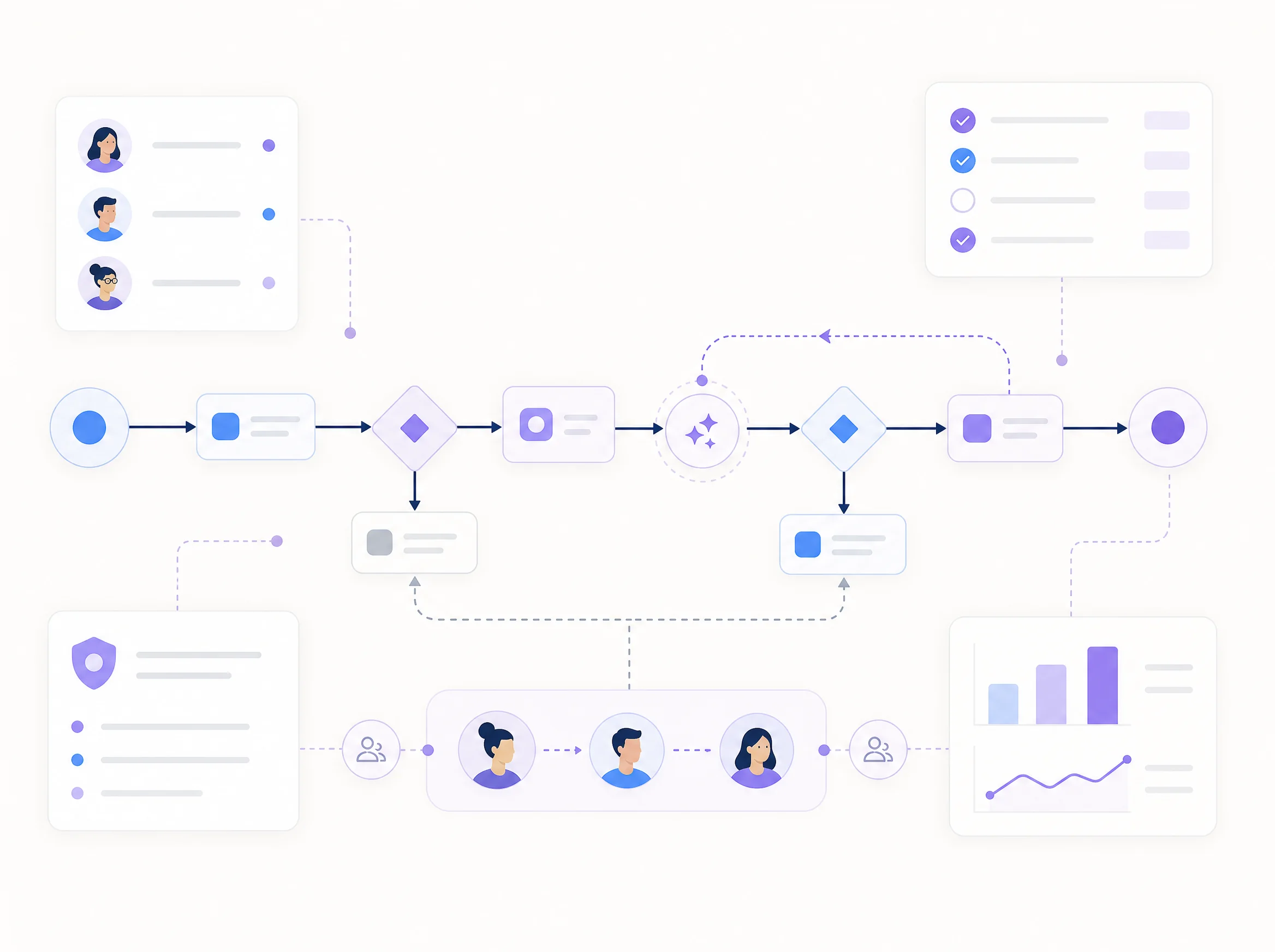
AI Agents in Business: Why the Real Issue Is Not the Tool, but the Process
Most companies do not have an AI problem. They have a process problem.
They buy tools. They test demos. They ask employees to “use AI more.” They launch pilots. They expect productivity to improve. But after a few weeks, the result is often disappointing.
The tool works. The demo looked impressive. The AI can summarize, classify, answer, draft, and analyze. Yet the business does not really change. Why? Because the company added AI on top of a broken or unclear process.
The real question is not “Which AI tool should we use?” The real question is: “What process are we trying to improve, and what should happen differently because of AI?” That is where most AI projects either succeed or fail — not in the model, not in the interface, but in the workflow.
The tool is not the transformation
Many companies approach AI like a software purchase. They ask which platform is best, which model is most powerful, which vendor has the best demo. These questions matter, but they are not the starting point. A business does not become more efficient because it has access to AI. It becomes more efficient when AI changes how work gets done.
A recruitment team does not need “AI” — it needs a better way to read, compare and shortlist candidates. A medical office does not need “AI” — it needs fewer missed calls and faster patient responses. A construction company needs field incidents and safety observations captured before they disappear. A legal team needs faster access to the right clause or precedent. A fiduciary needs to retrieve client information and cut manual back-and-forth.
The AI tool is only useful if it fits into that reality. Otherwise it becomes a shiny layer on top of the same old friction.
The real problem is unclear work
Business processes are messier than they look. From the outside they seem simple: receive a request, analyse it, find the right information, decide, respond, update the system, follow up. Inside the company, it is rarely that clean. Information is spread across emails, PDFs, spreadsheets, CRMs, shared drives and people's heads. Rules are not always written down. Different employees handle the same task differently.
When a company introduces AI into this environment without clarifying the process, the AI has nothing stable to support. It may generate answers, but not necessarily the right ones. It may automate a task, but not necessarily the task that matters. This is why many AI pilots look good in isolation but fail in daily operations: the demo shows what the AI can do; the process reveals whether the AI is actually useful.
A strong AI agent starts with the workflow
A good business AI agent is not just a chatbot. It should be designed around a workflow. That means defining:
- What task should the agent support, and who uses it?
- When is it triggered, and what information does it need?
- What systems should it access, and what should it produce?
- Who reviews the output, and what happens after approval?
- What should the agent never do? How will performance be measured?
These are not technical details — they are the foundation. An AI recruitment agent should not simply “analyse CVs.” It should read all applications, compare them against role criteria, summarise relevant experience, highlight missing information, suggest screening questions, prepare a structured shortlist, and leave the final decision to the recruiter. That is a process. The more clearly the process is defined, the more useful the agent becomes.
Why pilots often get stuck
Many companies run AI pilots. Fewer turn them into real operational systems. The reason is usually not that the AI is incapable — it is that the pilot was not connected to a measurable business process. A pilot that starts with a vague goal (“let's test AI for HR”) produces an interesting prototype but no clear path to value.
A useful pilot needs a specific operational question: Can we reduce CV screening time by 50% while keeping human review? Can we answer 70% of recurring internal questions without searching documents manually? Can we reduce missed calls in a medical office? Now the pilot has a baseline, a measurable outcome, and a reason to continue or stop.
The goal is not more AI. It is less friction
AI should not be deployed because it is trendy. It should be deployed because a specific part of the business is too slow, too manual, too inconsistent, or too dependent on one person's attention. The best use cases usually start with friction:
- Employees spend too much time searching for information.
- Customers wait too long for a response.
- Experts answer the same questions every week.
- Reports take hours to prepare; important details get lost in email threads.
- Follow-ups depend on memory; decisions are made without enough context.
An AI agent helps when it is designed to reduce that friction — not by replacing the whole team, but by removing repetitive steps, preparing better information, and helping humans act faster.
What should stay human
The more useful AI becomes, the more important human oversight becomes. An agent can support a process, but it should not own every decision. In most business contexts, humans should remain responsible for final decisions, exceptions, sensitive cases, client communication, legal or compliance judgement, and approval of important actions.
A good AI agent should know when to stop. It should be able to say: “I do not have enough information,” “This case requires human review,” “This request is outside the approved scope.” That is not a weakness — it is what makes the agent usable in a real business environment. The purpose of AI is not to remove responsibility; it is to support responsible execution.
Governance is part of the process
Governance is often treated as a separate compliance step. For AI agents, it must be built into the workflow: who can access the agent, what data it can use, what actions it can take, what outputs require approval, what logs are kept, and who is responsible if something goes wrong. These questions should be answered during design, not after deployment. Good governance does not slow AI down — it makes AI safe enough to use.
Data quality decides the result
An AI agent can only work with the information it has. If the company's data is incomplete, outdated, duplicated or hard to access, the agent will struggle. This is one of the most common problems in business AI projects: the company wants intelligent automation, but the underlying information is not ready. AI does not magically fix that — it exposes it. That is why an AI project often becomes a process and data project at the same time. A powerful model connected to poor data will only produce poor results faster.
What this changes for teams
When AI is introduced badly, employees feel threatened or confused. A better approach is to explain the process change: “This agent prepares the first summary, but you validate it. It drafts the response, but you approve it before sending. It reduces repetitive work so you can focus on judgement.” The best AI agents do not remove expertise — they make expertise easier to apply.
For managers, agents also create a new kind of visibility. They do not only execute tasks — they reveal patterns: which requests repeat, which documents are missing, which sites generate recurring safety observations, where leads are lost. That information helps managers improve the process itself, not just automate it.
Where BeLogic fits
At BeLogic, we believe AI agents should not be deployed as isolated tools — they should be designed around real business processes. Our approach starts with the workflow: what the team does today, where time is lost, where information is hard to find, where decisions need support, and where human review must remain. Then we design AI agents that fit that process — for recruitment, HSE, customer calls, internal knowledge, document analysis, accounting, medical-office administration or real-estate lead handling.
The principle stays the same: the AI should not be a gadget. It should be part of a clearer, safer, more efficient way of working. Because the real issue is not whether your company has an AI tool — it is whether your process is ready for one.
Quick checklist: is your business ready for an AI agent?
Your company may be ready if your teams repeat the same manual tasks every week, employees spend too much time searching for information, important requests get lost in emails, your process depends too much on one person's memory, or you have already tested AI tools without seeing real impact. If several of these sound familiar, the next step is not to buy another AI tool — it is to map the process, then decide where an AI agent can help.