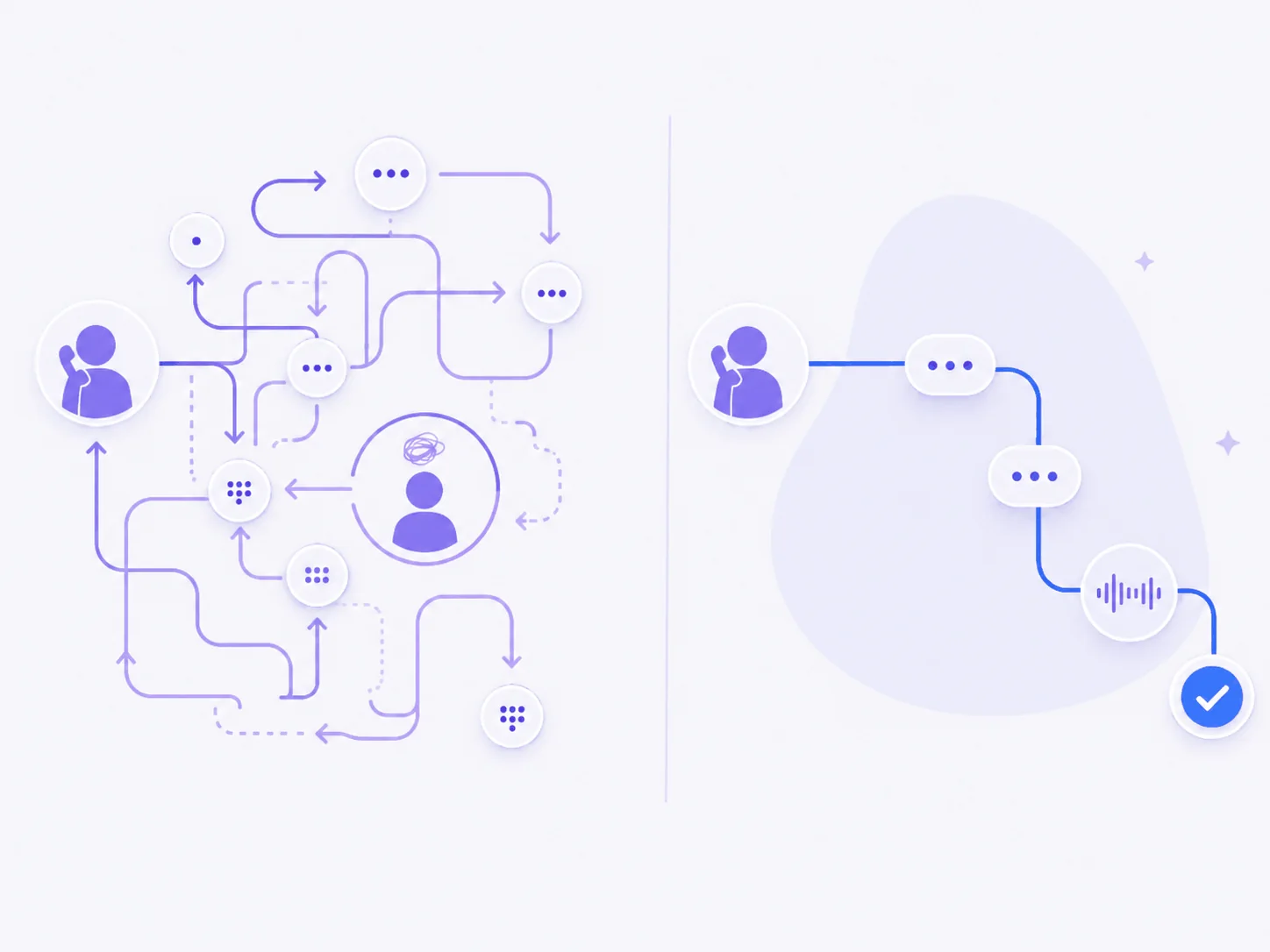
AI voice agent vs IVR: why traditional phone automation feels broken
You call a company. A recorded voice answers. Press 1. Then 3. Then 2. Wrong option. Start again. You ask for a human. The system doesn't understand.
Everyone knows the feeling. That's IVR — Interactive Voice Response. And most people quietly hate it.
Which is a little unfair, because IVR was built for a good reason: to absorb call volume and route requests to the right team. The idea isn't the problem. The problem is that most IVR systems were built around the company's internal structure — not around the caller's actual need.
What IVR does well
Let's be fair: IVR isn't useless.
For a high-volume company, it does real work: it routes. "Press 1 for sales, press 2 for support." When the request is simple and the menu is short, it works. The caller reaches the right team faster, and reception isn't buried under manual transfers.
IVR holds up as long as two conditions are met: the request fits one clear category, and the menu stays short. The moment either one breaks, the experience degrades.
Why IVR feels broken
Here's the fundamental design flaw: IVR asks the caller to understand the company's categories.
But customers don't think in departments. They think in problems. They don't think "I need to reach the scheduling team." They think "I need to change my appointment" or "my delivery didn't arrive." A rigid IVR forces them to translate their need into your org chart — a task they have no reason to get right.
The symptoms are always the same:
- The menus are too long — by the third level, the caller has forgotten option 1.
- People choose the wrong department and get transferred to the wrong place.
- After a transfer, they have to repeat everything to the next person.
- An urgent call isn't recognized as urgent — it waits in the same queue as everything else.
- A caller who speaks another language is left to cope.
- Voicemail is disconnected from follow-up: a message lands in a box nobody checks fast enough.
None of these are bugs. They're the limits of a fixed decision tree that never adapts to the person on the line.
The real difference
It fits in one sentence.
IVR asks callers to choose from a menu. An AI voice agent asks callers what they need.
IVR follows a fixed tree. An AI voice agent follows intent. "Press 1 for sales, press 2 for…" on one side; "Hi, how can I help you today?" on the other.
That's not a cosmetic detail. It's a complete reversal of the burden: it's no longer the caller's job to understand the company — it's the agent's job to understand the caller.
What an AI voice agent can do that IVR cannot
An AI voice agent doesn't just route. It can:
- understand a request spoken in natural language, with no menu;
- ask clarifying questions when the request is ambiguous;
- identify the real intent behind the words;
- handle multiple languages without holding or transferring the caller;
- qualify the request and collect missing information;
- book an appointment straight into the calendar;
- detect urgency and escalate it first;
- summarize the call and update the CRM;
- transfer to a human with context — a summary, instead of making the caller repeat everything.
Here are the two worlds side by side:
| Traditional IVR | AI voice agent | |
|---|---|---|
| How it works | Fixed menu tree | Understands intent |
| What the caller does | Picks an option, presses a key | Explains the need in their own words |
| Best for | Simple routing, short menu | Varied, nuanced requests |
| Multilingual | One option per language, at best | Switches language mid-call |
| Follow-up | Voicemail isolated from the CRM | Automatic summary and CRM record |
| Human transfer | Caller repeats everything | Transfer with summary and context |
An AI voice agent still needs limits
Let's be clear: an AI voice agent isn't meant to absorb everything.
Some calls should go to a human — an angry customer, a complex complaint, a sensitive negotiation, a major opportunity. A good agent is honest about escalation. It knows what it shouldn't handle alone, and it transfers without wasting the caller's time.
And it doesn't pretend to be human. A voice agent that disguises itself as a person always disappoints in the end. A voice agent that is clear, useful and easy to escalate past earns trust.
You don't have to remove your IVR
This isn't a binary choice.
The real question isn't "IVR or no IVR." It's: where does your IVR create friction an AI voice agent could remove?
Start with specific call types: missed calls, after-hours calls, appointment requests, lead qualification, multilingual reception. Wherever the menu loses people, the voice agent recovers them.
IVR helped you manage volume. An AI voice agent helps you manage meaning. That's exactly Voxora's job.