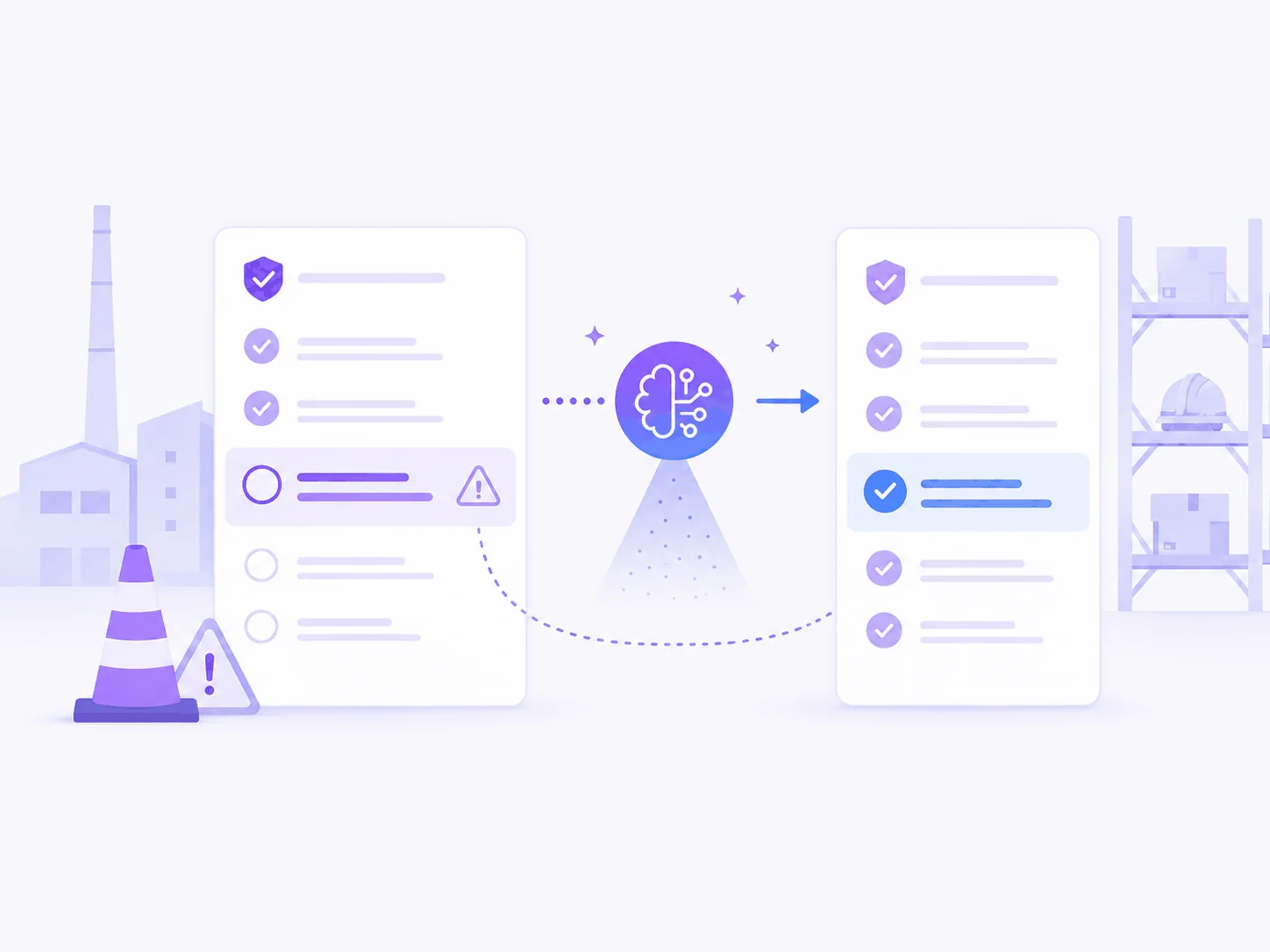
Why corrective actions stay open after HSE audits
An HSE audit is only useful if something changes afterward. Finding the gap is step one. The real test is what happens next.
In many companies, corrective actions stay open long after the audit. Not because HSE teams don't care — usually the opposite. But because follow-up is harder than finding the problem.
The audit ends, the work begins
The audit report lands on the desk. Every finding becomes a task: fix the hazard, update the procedure, retrain an operator, repair a piece of equipment, gather documents, verify, upload proof, close.
On paper, that's simple. In reality, every corrective action competes with daily operations. Production doesn't stop to let you close a finding. And while it waits, an open action isn't a line in a spreadsheet. It's a known risk that hasn't been controlled yet.
Why corrective actions stay open
The reasons almost always come back to the same five. And none of them is about a lack of goodwill.
1. Ownership is unclear. The action is assigned to a department, not a person. "Maintenance to fix." But maintenance is eight people. When everyone owns it, nobody does. An action with no name on it is an action that doesn't move.
2. The action is too vague. "Improve housekeeping in the storage area." Nobody knows what "done" looks like. A good action is specific: "Clear the blocked walkway in storage area B, add floor marking, upload a photo as evidence by Friday." Now you know when it's finished.
3. Evidence is missing. A manager says "it's fixed." But HSE needs proof — a photo, a training record, a maintenance report. If that proof is scattered across emails and three SharePoint folders, closure drags, even when the work is done.
4. Low-risk and high-risk actions are mixed together. The list doesn't tell them apart. The result: easy actions get closed first — they feel like progress — and the serious, heavier ones stay open. The dashboard goes green while the real risk sleeps.
5. The same gap keeps coming back. The action treated the symptom, not the cause. You clear the walkway; three weeks later it's blocked again. ISO 45001 explicitly ties corrective action to continual improvement: fixing without understanding the cause isn't fixing — it's postponing.
How AI helps close them
Let's be clear: AI doesn't replace responsibility. Nobody relieves an HSE manager of their obligations by plugging in an agent. But Sentinel targets exactly the friction that leaves actions open:
- Turn an audit finding into a clear, structured action — with an objective, a named owner, a deadline.
- Flag actions missing an owner, a date or evidence, before they get stuck.
- Prioritize by risk and recurrence, so serious actions are no longer buried under easy ones.
- Verify photo evidence faster — compare the photo of the issue with the photo of the fix.
- Detect actions marked "closed" but not actually solved: if the same gap reappears, Sentinel sees it.
- Prepare audit-ready evidence: finding, owner, deadline, evidence, closure date, recurrence history.
It's not magic. It's follow-up, done relentlessly, by something that never files the report away in a drawer.
What AI should not do
The boundary matters as much as the feature. Sentinel doesn't auto-close a serious action without human validation. He doesn't ignore local context — a safety officer knows things about their site that no dataset captures. He doesn't make disciplinary decisions. And he doesn't claim a certainty the evidence doesn't support.
The safe design fits in one sentence: AI tracks, suggests, prioritizes and checks evidence — humans decide and own. An agent that quietly closed gaps to turn a dashboard green wouldn't be a safety tool. It would be a new risk.
An audit isn't about its report
Here's the idea to keep. The value of an HSE audit isn't the document it produces. It isn't the number of findings, or the thickness of the report, or the satisfaction of having wrapped it up.
The value of an audit is the risk you remove after the report. Everything else is just documentation. A corrective action left open too long is an audit that stopped halfway through.
That's exactly Sentinel's job: making sure what gets found actually gets fixed — and stays fixed.