AI recruitment agent vs ATS: why your ATS isn't enough
An ATS tells you where every candidate is. It doesn't tell you whether you just walked past the right one.
As a company grows, it eventually buys an ATS — an Applicant Tracking System. And it should. Running recruitment from a shared inbox and a spreadsheet stops working past a handful of roles a year.
The problem isn't that an ATS is useless. The problem is that companies expect too much from it.
Here's the line worth keeping: an ATS helps you manage candidates. It doesn't help you understand them.
What an ATS does well
An ATS is an excellent management tool. On that ground, it does its job:
- Publish jobs across multiple channels
- Collect every application in one place
- Store CVs and cover letters
- Track each candidate's status in the pipeline
- Manage interview stages and scheduling
- Centralize recruiter and hiring-manager notes
- Keep useful compliance records
In short, an ATS tells you where each candidate sits in the process. That's valuable. But it isn't the same as knowing who that candidate is.
Where an ATS falls short
An ATS hits its limit at exactly the hardest stage: the first screening.
Picture a role that gets 200 applications. The ATS collects them all. The dashboard is tidy, the statuses are current, everything is filed. And yet someone still has to:
- Read all 200 CVs
- Judge whether the experience is genuinely relevant
- Compare profiles fairly
- Spot transferable skills that don't jump off the page
- Notice strong candidates who didn't use the exact keywords
The ATS does none of this. It files; it doesn't judge. And the keyword filter that often gets bolted on doesn't replace judgment — it imitates it, badly. The Harvard Business School and Accenture report on "hidden workers" makes this plain: rigid filters exclude perfectly qualified people because they focus on what those people lack rather than what they can actually do.
Storage is not interpretation
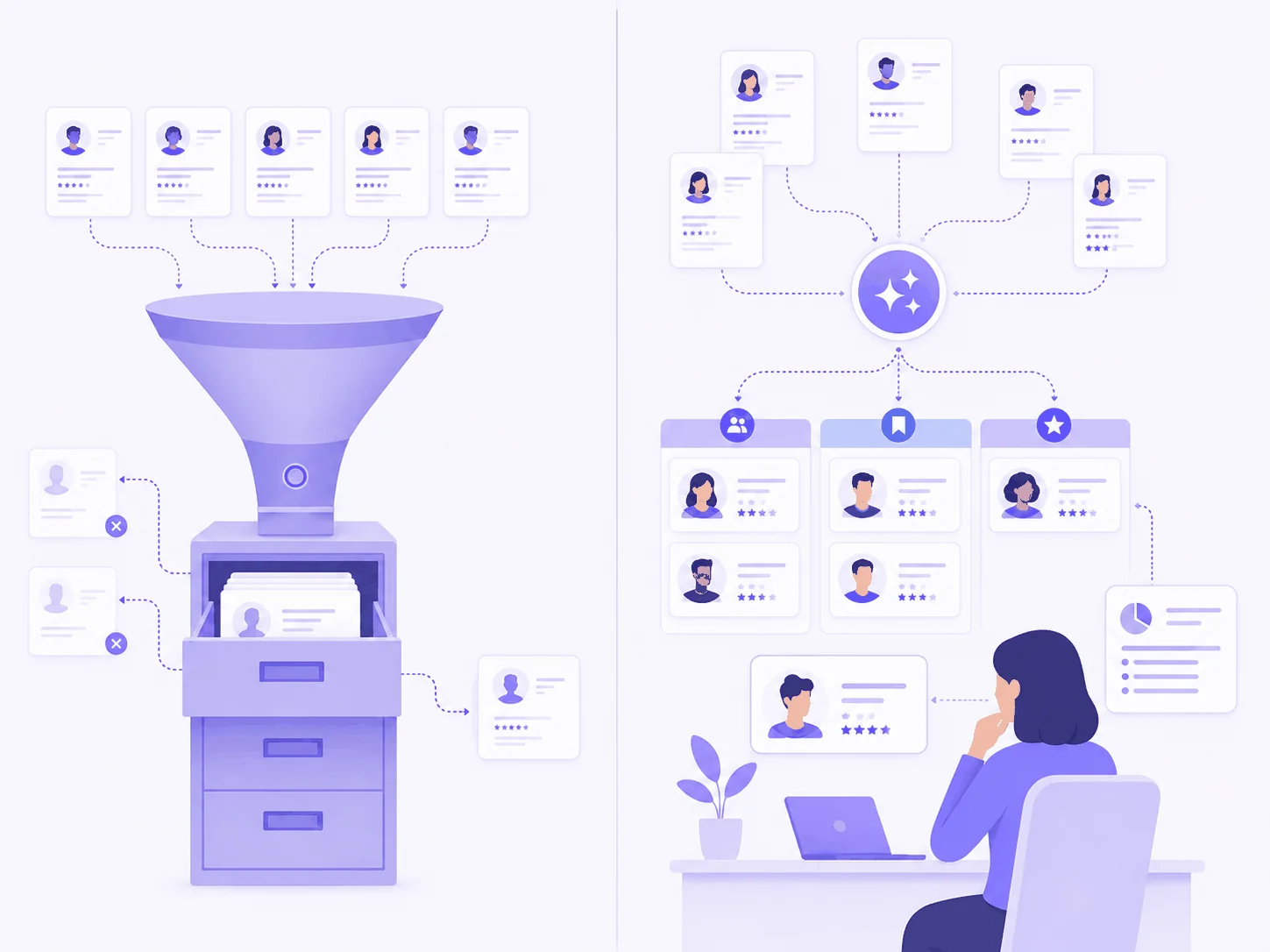
The clearest way to see the difference: the ATS is the filing system. It sorts the records, retrieves them, dates them. But it doesn't read their contents for you.
That's exactly the job of an AI recruitment agent. Where the ATS stores, the agent interprets:
- It reads every CV — not one in three, all of them
- It summarizes the experience relevant to the role
- It compares each profile against the real role criteria
- It identifies transferable skills
- It flags missing information
- It suggests screening questions
- It groups candidates by level of fit
- It explains why a profile is relevant
- It prepares structured shortlists for human review
The ATS answers "where are we?". The AI agent answers "who deserves an interview?".
Why keywords aren't enough
The keyword filter rests on a false assumption: that people describe their work using exactly the same terms as your job posting.
They almost never do. A candidate may have three years of "customer success" experience and never write "account management". A technician may have a solid safety background without ever typing "HSE compliance" on a CV. An experienced salesperson may talk about "portfolio growth" while your posting asks for "business development".
A rigid system ranks these people too low. They exist in the ATS, but they vanish under the pile. An AI agent looks beyond the exact wording: it understands that two different phrases can describe the same skill.
A keyword is not proof of competence. And a badly worded CV is not a bad candidate.
The ATS stays the system of record
Let's be clear: this is not about replacing your ATS. The AI agent sits next to it, not in its place.
The workflow is simple. Candidates apply through the ATS. The agent reads and summarizes each application. It compares it against the role criteria. Recruiters review the highlighted profiles. Humans approve the shortlist. Notes go back into the ATS, which stays the memory of the process.
Each does what it does best: the ATS manages the process, the AI improves the screening, the human decides.
When an ATS is enough, and when it isn't
An ATS on its own can be perfectly sufficient if you hire infrequently, for simple roles, with an application volume your team reads comfortably.
You need an agent the moment three signals appear: you receive more CVs than the team can read; good candidates are spotted too late, sometimes after they've signed elsewhere; your keyword filters are visibly rejecting too many people.
The ATS isn't the problem. It does exactly what it was designed to do. It's just not enough. That's Nova's job: she doesn't decide who you hire — she makes sure the strong candidate isn't lost in the pile because nobody had time to read the CV.