Five HSE risks your ERP, HR system and SharePoint already know about
Most HSE risks don't come from nowhere. The signal was there. Nobody connected it.
We tend to picture an accident as a thunderclap: unpredictable, sudden, with no warning. The reality is less dramatic and more uncomfortable. Before most incidents, there were signs. Several of them. Readable.
The problem is almost never a lack of information. It is that the information is scattered — a piece in the ERP, a piece in the HR system, a piece in the maintenance logs, a piece in SharePoint — and nobody connects it until the audit. Or until the incident.
Your company already owns its safety data. Taken together, that data forms early-warning signals — what OSHA calls leading indicators. Here are five risks your systems already know about, and that nobody has time to see.
Risk 1 — Training gaps in high-risk roles
The HR system knows uncomfortable things. It knows a forklift operator has an expired operating certification. It knows an operator never completed the electrical-safety training his role requires. It knows a new hire is assigned to a hazardous zone before his safety induction.
In isolation, each line is harmless — a date in a table. The risk only appears at the crossing point: when that HR data is set against the operations schedule. Nobody runs that cross-check every Monday morning.
An AI does. It flags: "Three employees scheduled for high-risk work next week have missing or expired safety training." Not a report. An alert, before the person climbs onto the machine.
Risk 2 — Repeated maintenance issues on safety-critical equipment
The CMMS records every intervention. A breakdown on a safety system. A preventive maintenance pushed back. A "temporary" repair that has lasted six months.
Each ticket, on its own, is normal. It is their accumulation that tells a different story: a safety device degrading slowly. The pattern is only readable when you look at the full history of one asset — exactly what no daily schedule does.
The useful alert looks like this: "This safety-critical asset generated five maintenance tickets in 30 days, and its preventive maintenance is overdue." Ticket number six is no longer a breakdown. It is a warning.
Risk 3 — Outdated procedures hiding in SharePoint
SharePoint is where procedures go to quietly die. An up-to-date version exists somewhere — but an older version, saved locally, keeps being used on the floor. A document was revised without anyone being told. Two folders hold two conflicting versions of the same instruction.
The result: the official procedure and the real procedure drift apart, slowly, without anyone deciding anything. On audit day, you discover the workshop is working to a version withdrawn two years ago.
Version control is not a bureaucratic detail. It is the difference between "the right step is written down" and "the right step is actually done."
Risk 4 — Contractor compliance gaps
A contractor lives at the border of five systems: procurement, the HR system, operations, HSE and SharePoint. If those systems do not talk to each other, what always happens, happens — a contractor arrives on site before everything is ready.
Expired insurance. A missing certificate. No site induction completed. A method statement that was never approved. Every one of those facts exists — in some system. None of them was brought together in time.
The alert that would have prevented the accident: "Contractor X is scheduled for confined-space work tomorrow, but the latest method statement is missing." The day before, not the day after.
Risk 5 — Corrective actions open too long
An overdue corrective action is a known risk — identified, written down, documented — but not yet controlled. And there are always more of them than you think.
The reasons are always the same: the deadline has passed, ownership is unclear, the evidence of closure is missing. The action exists in a tracking sheet. The sheet, however, alerts nobody. It waits to be opened.
A corrective action open for 90 days on a serious risk is not an administrative delay. It is a safety gap with an opening date.
The real value of AI here: connection
Take the five risks again. None of them is invisible. The HR system knows about Risk 1. The CMMS knows about Risk 2. SharePoint holds Risks 3 and 4. The action tracker holds Risk 5.
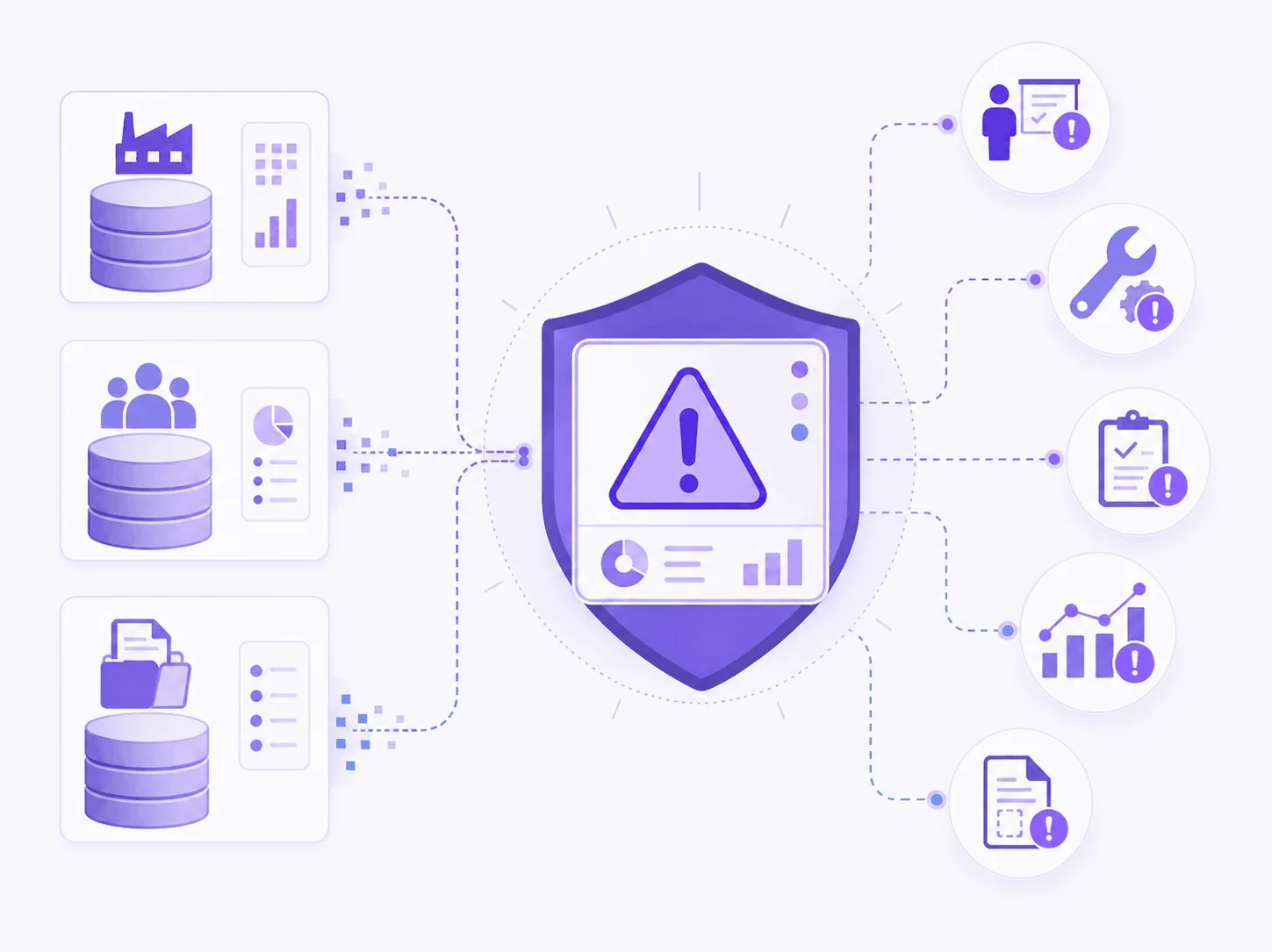
The problem is not a shortage of data. It is that connecting these signals — every day, across every system, missing nothing — is beyond what a human can do between two meetings. That is precisely what an agent like Sentinel does: it joins signals nobody has time to join.
Proactive safety is not more paperwork. It is better timing — seeing the risk while it is still a weak signal, not once it has become an incident. That is Sentinel's job.