Chatbot, copilot, or AI agent: what your business actually needs
Every company wants to "use AI." The problem: that sentence means nothing — and picking the wrong category is expensive.
"We want to do AI." You have heard that sentence in every leadership meeting for three years. It is too vague to be useful. It is like saying "we want to do digital" in 2005.
Behind that single word — AI — sit three very different families of tools. They do not solve the same problems, do not cost the same, and do not require the same level of oversight. Confuse the three and you buy a tool that will never fix the problem you set out to fix.
The difference, one sentence each
No jargon needed. Here are the three categories:
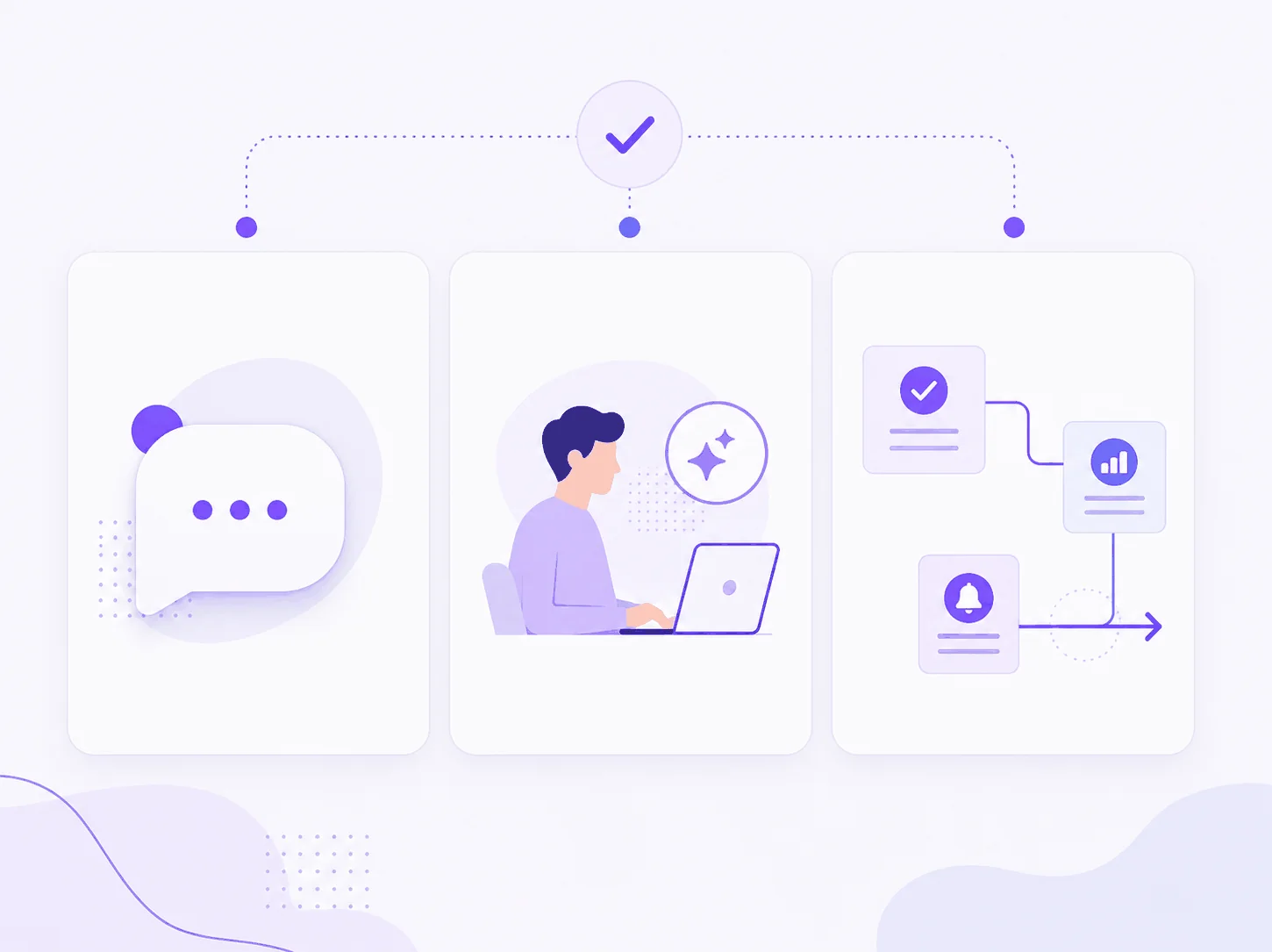
- A chatbot answers questions. It is reactive: you ask, it answers. That is it.
- A copilot helps a human work faster. It works beside a person — write, summarize, analyze.
- An AI agent performs a task or a workflow. It is operational: it follows a process, uses tools, decides within set rules, and escalates when needed.
The chatbot talks. The copilot assists. The agent does. This is not a marketing nuance: it is the difference between three projects, three budgets and three outcomes.
When you need a chatbot
A chatbot is the right call when your customers or teams repeatedly ask questions whose answers already exist: opening hours, order status, how to book, FAQ, internal knowledge base.
It saves real time on simple, repetitive requests. But its limit is sharp: a chatbot does not own the process after the answer. It tells you how to book an appointment — it does not book it. It tells you where the form is — it does not process it. If your problem starts where the conversation ends, the chatbot is not the solution.
When you need a copilot
A copilot is the right call when you want to make your employees more productive at their existing work: drafting emails, summarizing meetings, analyzing a long document, structuring a note.
The copilot is powerful, but there is one thing to understand: the task still belongs to the human. The copilot waits to be asked. It owns no process, triggers nothing on its own, carries no operational responsibility. If nobody opens it, nothing happens. It is an excellent accelerator — not an autonomous worker.
When you need an AI agent
An AI agent is the right call when a task must be handled start to finish, reliably, within clear rules — even when your teams are busy. A voice agent that answers missed calls. A recruitment agent that reads CVs. An HSE agent that analyzes site photos.
Unlike a chatbot or a copilot, the agent owns the workflow. But that is not something you improvise. A well-designed AI agent needs:
- A clear and bounded objective
- Defined rules on what it can and cannot do
- Access to the right tools and the right data
- Escalation paths to a human
- Human validation on sensitive decisions
- Logs and limits — so it stays traceable and auditable
You choose an agent when the problem sounds like: "this workflow must happen reliably, even when the team has no time."
The mistake to avoid: starting with the technology
Here is the most common — and most expensive — mistake. A company says: "we need a chatbot."
But a chatbot is not a problem. It is a solution. And nobody has checked which problem it answers. The real problem sounds completely different: "we miss calls after 6 p.m.", or "we cannot screen applications fast enough."
Always start from the operational pain, never from the tool. The real need decides the category:
- "Customers keep asking the same questions" → chatbot
- "My teams spend too much time writing and summarizing" → copilot
- "This workflow must run even when nobody is available" → AI agent
Adopting AI is not the same as creating value. A tool that gets used is not necessarily a tool that is useful.
Many companies measure their "AI transformation" by the number of tools deployed. That is the wrong metric. The only question that matters is not "how can we use AI?" — it is "which process should AI improve first?"
That is exactly where BeLogic starts. Not with the technology, not with the demo that impresses. With the process that costs you the most to leave broken — and with the category of AI that actually fixes it.