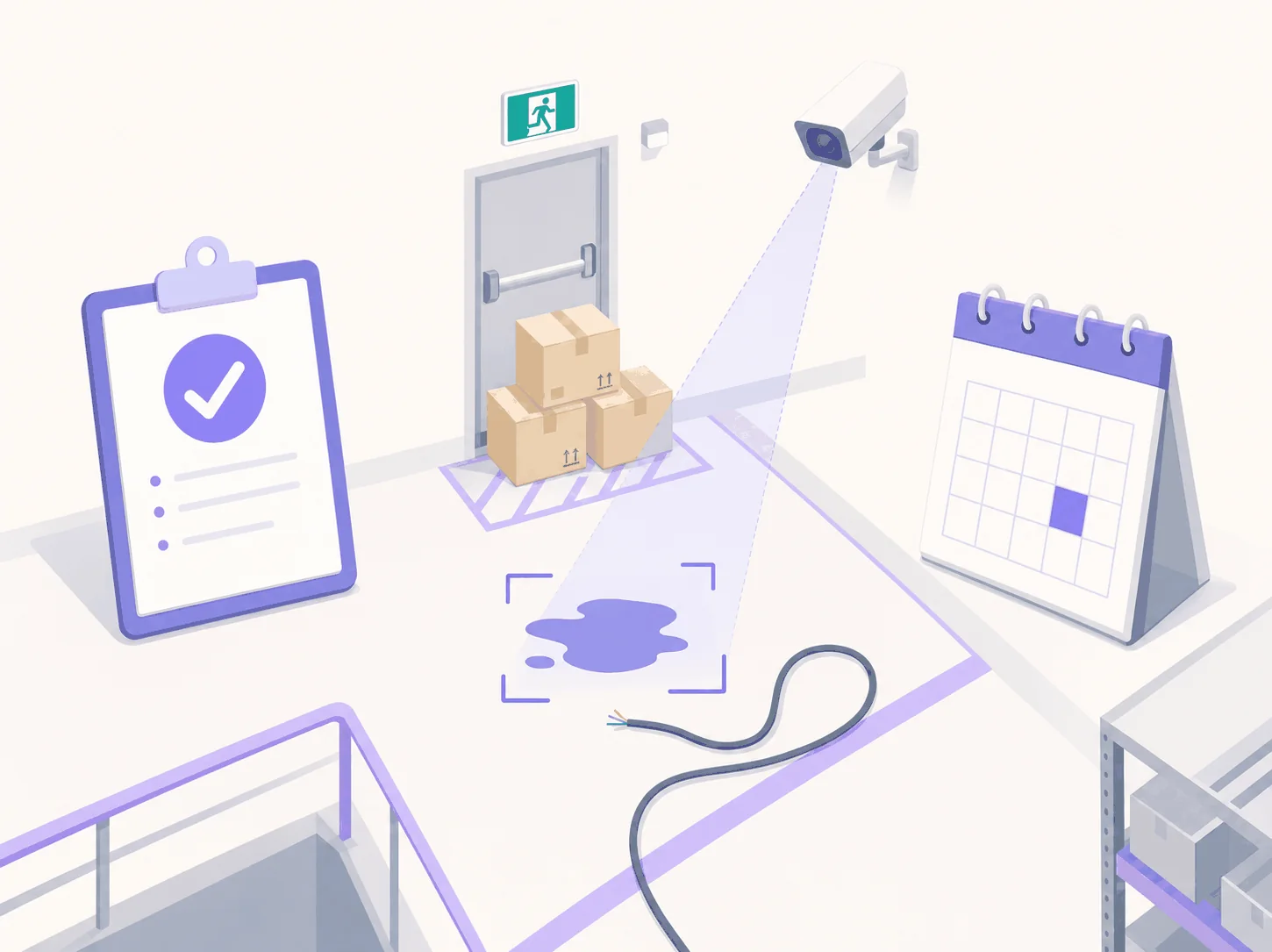
Why HSE audits are always too late
The audit isn't the problem. The problem is everything that happens between two audits — while nobody is watching.
Let's be clear up front: a well-run HSE audit is useful. It verifies compliance, it structures the process, it feeds certification. Nobody at BeLogic will tell you to stop auditing.
But an audit has a design flaw that no methodology will ever fix: it is periodic. It finds risks after they've already appeared. And between two visits, risk doesn't wait.
The audit is a checkpoint. The shop floor is a continuous flow
Weekly, monthly, quarterly, annual — whatever the cadence, an audit is still a photo taken at a single moment. Risk on the ground is a film that runs without interruption.
Take a mundane example. Monday morning, a walkway in the warehouse is partly blocked by pallets left there "just for now." Nobody moves the pallets. Tuesday, people walk around them. Wednesday, they walk around without even thinking about it. By Friday the obstacle is invisible: everyone has absorbed the detour, and the blocked walkway is now part of the site's "normal" operation.
Nothing has happened. No accident. But the risk has settled in. It's now part of operations.
At the next audit — in three weeks, in three months — the auditor will spot the walkway and log it as a non-conformity. They will have done their job. Correctly. But with a lag. And it's that lag that gets expensive.
Lagging indicators versus leading indicators
Classic HSE is measured mostly with lagging indicators: injuries, incidents, non-conformities, frequency rates. They all have one thing in common — they describe what has already failed. They're precise, they're necessary, but they look in the rear-view mirror.
Leading indicators — the term OSHA uses — work differently. They are proactive signals that show where the system is weakening before something breaks: a walkway that's getting blocked, a piece of PPE that's no longer worn, storage that's starting to drift.
The problem is simple: a semi-annual audit mostly produces lagging indicators, while real prevention needs leading ones. Nobody gets hurt because an audit ran too late. People get hurt because the weak signal was seen by no one in between.
What photo-based safety monitoring changes
There's nothing futuristic about the idea. Workers and supervisors regularly photograph their work environment — from their phone, in a few seconds. AI analyzes each image and flags the visible risks:
- Blocked emergency exits
- Missing or incorrect PPE
- Poor housekeeping
- Unsafe or non-compliant storage and stacking
- Blocked walkways
- Spills and slippery floors
- Damaged equipment
- Missing safety signage
- Exposed cables on the floor
- Working at height without visible protection
The loop is short and readable: photo → analysis → alert → human review → corrective action → audit trail. No committee, no spreadsheet, no waiting. The risk is seen the day it appears, not three months later.
That's the difference between a photo and a film reel. The audit is the checkpoint. Photo-based monitoring is the camera roll of daily reality.
What AI should not claim to do
Here, honesty isn't optional — it's what separates a serious tool from an empty pitch.
AI that analyzes photos sees visible risks. It does not see everything. It cannot reliably detect:
- worker fatigue;
- safety-culture problems;
- invisible chemical exposure;
- an internal machine failure;
- training gaps;
- any risk outside the photo frame.
Photo-based monitoring delivers better visibility. Not magic. Responsibility stays human — the AI alerts, but it's the safety officer who decides, judges and acts. A tool that claims to "see everything" is lying, and a lie in HSE always gets paid for eventually.
Photo monitoring does not replace the audit
It needs saying plainly: this is not a replacement. It's a complement that acts where the audit is, by nature, powerless — between audits.
The audit verifies compliance and supports certification. Photo monitoring improves what happens the rest of the year, when no auditor is on site. The two don't play the same role, and that's exactly why they fit together.
Compliance asks: "can we prove we followed the process?" Prevention asks: "can we see the risk before someone gets hurt?" Only prevention buys you time.
An audit tells you where you were. Continuous monitoring tells you where you are. And on an industrial site, it's the second piece of information that prevents accidents.
That's exactly Sentinel's job: turning safety from a periodic exercise into continuous attention — without adding to anyone's workload.