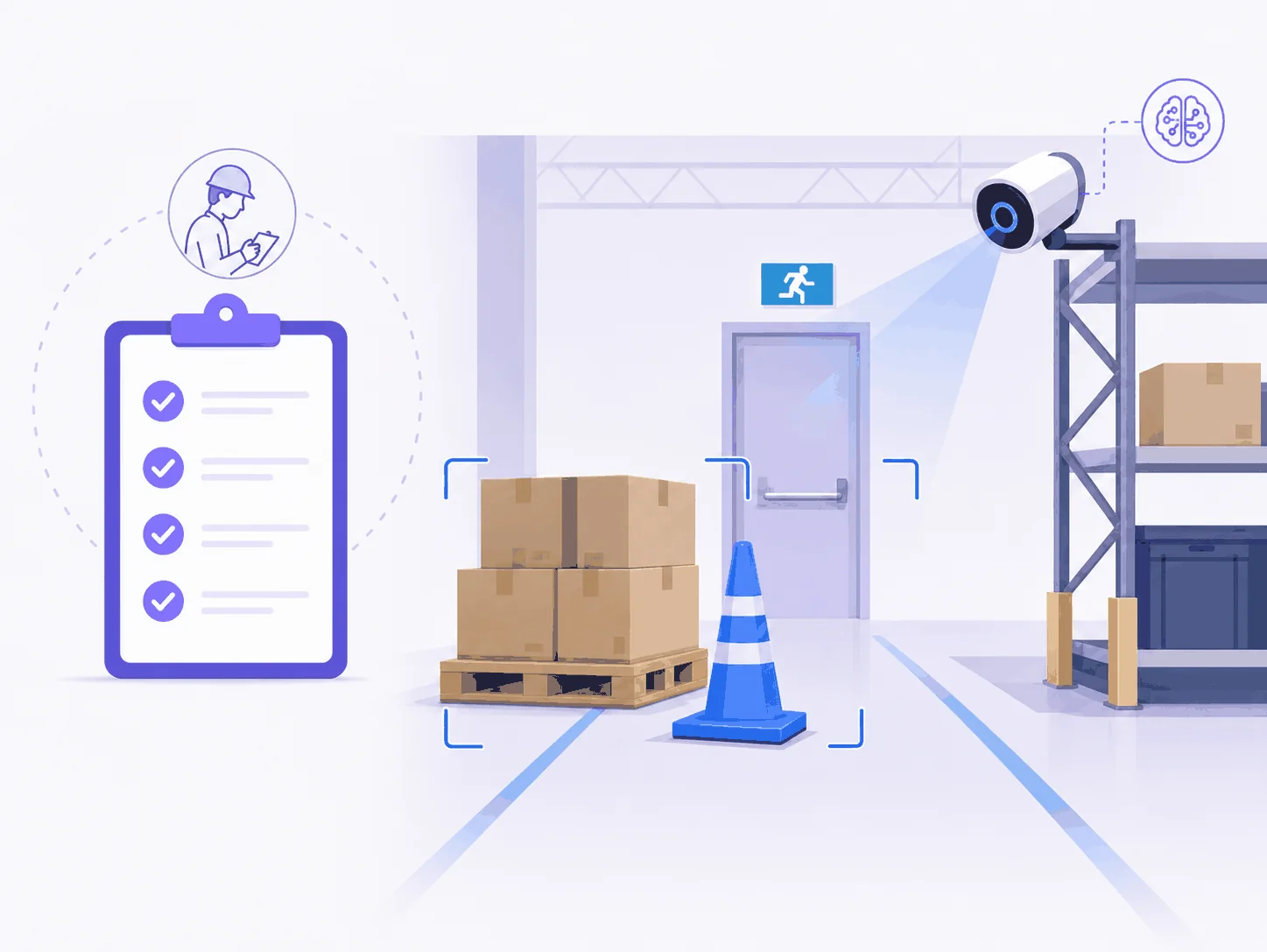
HSE: what AI sees that your auditors miss
HSE auditing has a latency problem. And a fragmentation problem. And a memory problem.
A senior safety officer visits an industrial site twice a year. For two days. He looks at PPE, safety data sheets, registers, procedures. He identifies on average twenty-three gaps per audit. He writes a report. He hands it in.
Three months later, seven of those gaps still aren't closed. Two new ones have appeared. Nobody knows.
Here's the problem with HSE auditing in 2026: it has a clock frequency that's incompatible with the reality on the ground.
The latency problem
A semi-annual audit means 4,320 hours between two visits. During those 4,320 hours, your site changes. Temp workers arrive without up-to-date training. PPE is replaced with a non-compliant model because the regular supplier is out of stock. A procedure is printed but never signed. A job description is modified without the risk register being updated.
When your auditor comes back six months later, he's looking at a photo. Not a film.
Sentinel isn't an auditor. Sentinel is a continuous monitor. He cross-references HRIS records, PPE purchase orders, training schedules, incident reports, and supplier safety data sheets in real time. He alerts before the audit. He alerts before the incident.
On a 200-person site, this means on average 47 alerts per month — including 6 critical ones. Six times a month, your safety officer receives a message that starts with: "Sentinel detected a gap in…".
The fragmentation problem
Here's what a human auditor cannot do in two days on site: cross-reference 14 systems.
On an average industrial site, HSE data is scattered across:
- The HRIS (training, certifications, occupational health)
- The ERP (PPE purchases, subcontractors, contracts)
- The CMMS (maintenance, periodic inspections)
- The incident register (often an Excel sheet)
- Supplier safety data sheets (PDFs in a SharePoint)
- Quality procedures (another SharePoint)
- Works council meeting minutes (PDF per month)
- Approved-body reports (electrical inspections, lifting equipment…)
- Prevention plans (one per subcontractor)
No human reads all of this. No human can. Sentinel, on the other hand, ingests these streams continuously, correlates them, and finds the gaps that only appear at the intersection — like that subcontractor on a prevention plan whose electrical certification expired three weeks ago, but who is scheduled to intervene tomorrow.
That's exactly the kind of gap that triggers a serious accident. And it's exactly the kind of gap that a semi-annual audit cannot see.
The memory problem
A safety officer changes roles every 4 to 5 years. When they leave, they take their tacit knowledge with them: why this gap is recurring, who on the team tends to forget signing permits, which workshop has a history of incidents tied to a specific process.
This memory doesn't transfer. It gets rebuilt. Badly. Slowly.
Sentinel is institutional memory. He keeps a record of every historical gap, every corrective action, every recurrence. He identifies patterns no one has time to see: gaps that recur at every audit, workshops where a type of incident keeps coming back, suppliers whose SDS are systematically out of date.
This memory is operational. It doesn't sit in a binder. It alerts.
Three gaps Sentinel flagged that nobody had seen
Here are three real cases (anonymized):
Case 1 — The phantom training. An operator was listed as "trained for forklift operation" in the HRIS. But his training dated from 2017 and had been delivered by a body whose certification was withdrawn in 2020. Sentinel cross-referenced the HRIS with the official list of approved bodies. Action: retrain 3 operators, update the risk register.
Case 2 — The non-compliant PPE. The site's purchaser had switched to a new supplier of cut-resistant gloves on price grounds. The model offered had a level D protection rating instead of the level E required by the workstation's risk analysis. Sentinel compared the ordered PPE spec against the PPE/workstation matrix. Action: returned to supplier, no incident.
Case 3 — The drift in hot-work permits. Over the last quarter, 11 hot-work permits out of 47 had been issued without the intervention permit being signed by the principal. No incident — but an invisible procedural drift. Sentinel flagged the pattern. Action: training reminder and overhaul of the digital workflow.
None of these three gaps would have been detected by a semi-annual audit.
Sentinel doesn't replace your safety officer
That's the misunderstanding to kill right now.
Sentinel doesn't do site visits. He doesn't smell a gas leak in a workshop. He doesn't read the body language of an operator lying about their fatigue. He doesn't run a post-incident interview. He doesn't lobby the executive committee for a training budget.
Sentinel does what your safety officer doesn't have time to do: monitor 14 systems continuously, memorize ten years of gaps, alert before the audit.
The result: your safety officer spends less time compiling data, and more time preventing.
That's what agentic AI applied to HSE looks like. Not a robot that audits. A colleague that never sleeps.